

Adventure & Experience
Experience Awa Odori Dancing in Year-Round Performances at tonaru SETO

-
- DESTINATION NAME
- Tokushima
-
- RELATED TAGS
-
- LAST UPDATED
- 25 March, 2026
At Tokushima’s annual Awa Odori dance festival, thousands of elaborately costumed dancers parade through the streets, performing the region’s signature folk dance. Typically held between August 11–15, it is one of Japan’s most popular events, drawing well over a million spectators to the region each year.
So that more visitors can experience this unique, vibrant local tradition, Awa Odori dance performances are held year-round in the city of Naruto. These take place at tonaru SETO, a former elementary school that has been turned into a multipurpose facility for cultural and outdoor activities. After they watch the performance, visitors are taught the basic Awa Odori steps and encouraged to join in.

A Colorful, Swirling Spectacle of Music and Dance
Dances held during Obon, the traditional Japanese summer festival honoring family ancestors, are known as Bon Odori. Like many Bon Odori styles, the Tokushima style initially featured a more free-form dance, with participants rotating around a central point. It was only in the twentieth century that it was named the Awa Odori and organized as a large-scale street parade.

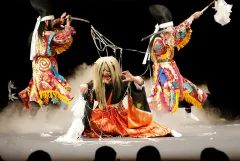
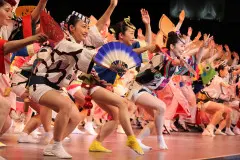
Awa Odori performances at tonaru SETO evoke the older tradition of a swirling, circulating spectacle. Female dancers wear colorful summer kimonos and wooden sandals. The distinctive half-moon shape of their braided straw amigasa hats is one of the most iconic symbols of the Awa Odori festival. Male dancers don short festival coats, with square belts wrapped around their waists and tabi socks on their feet. Most men wear a headband or cheek wraps tied beneath their nose.

Musicians accompany the dancers from a low platform beside the performance area. Some carry large drums (odaiko) that produce a deep, resounding beat, while others strike smaller cord-bound drums (shime daiko) in a lively, high-pitched rhythm. There are also musicians playing traditional wooden flutes (fue), handheld metal gongs (kane), and three-stringed shamisen, contributing to a cascade of distinct sounds. Dancers raise their voices, too, calling out rhythmic refrains like “eraiyaccha, eraiyaccha!” and “yattosa, yattosa!”

Awa Odori performances at tonaru SETO are held in the former Seto Elementary School gymnasium. The building’s interior has been transformed into a unique circular space, with the original gym floor serving as the stage. Elevated bench seating surrounds this central performance space, so audience members can view the dancers from multiple angles as they move.

A Celebration Where Anyone Can Join In
The musicians and dancers performing at tonaru SETO come from highly trained troupes that practice throughout the year. However, the annual Awa Odori festival in Tokushima is not just limited to these highly skilled performers. Troupes of varying abilities parade through the streets, reflecting the Awa Odori’s origins as a local folk dance. There is even a special session called Niwaka Ren that is open to anyone. As the popular festival song “Awa Yoshikono” urges, “Dancing fools and watching fools! Everyone’s a fool, so why not dance?”

This inclusive, communal spirit continues at tonaru SETO. After the performance, audience members are taught the steps of the dance and encouraged to take to the stage and join in. The men’s dance involves making expressive hand movements while bending at the knees and pointing the feet outward. The female dancers, balancing on the fronts of their wooden sandals, wave their hands above their heads while moving straight forward. In general, men dance freestyle, while women perform in tightly synchronized groups.
The presence of tonaru SETO within what was once a school echoes efforts to pass on the tradition of Awa Odori. Many students in Tokushima Prefecture learn the dance in elementary and junior high school. Older students in high school or university often join Awa Odori clubs that perform at the main August festival.
A Local School With Unique Architecture
After the Awa Odori experience is over, visitors are free to explore the school grounds. Architect Masuda Tomoya (1914–1981) designed the gymnasium and kindergarten buildings in an architectural style that is unusual for schools in Japan. The kindergarten is particularly striking, featuring high ceilings and large windows that provide views of the surrounding forest. It now serves as a free space for relaxing and enjoying drinks. Much of the rest of the school has been preserved, with desks and chairs remaining in the classrooms, staff room, and principal’s office.


Fishing on a Raft in the Seto Inland Sea
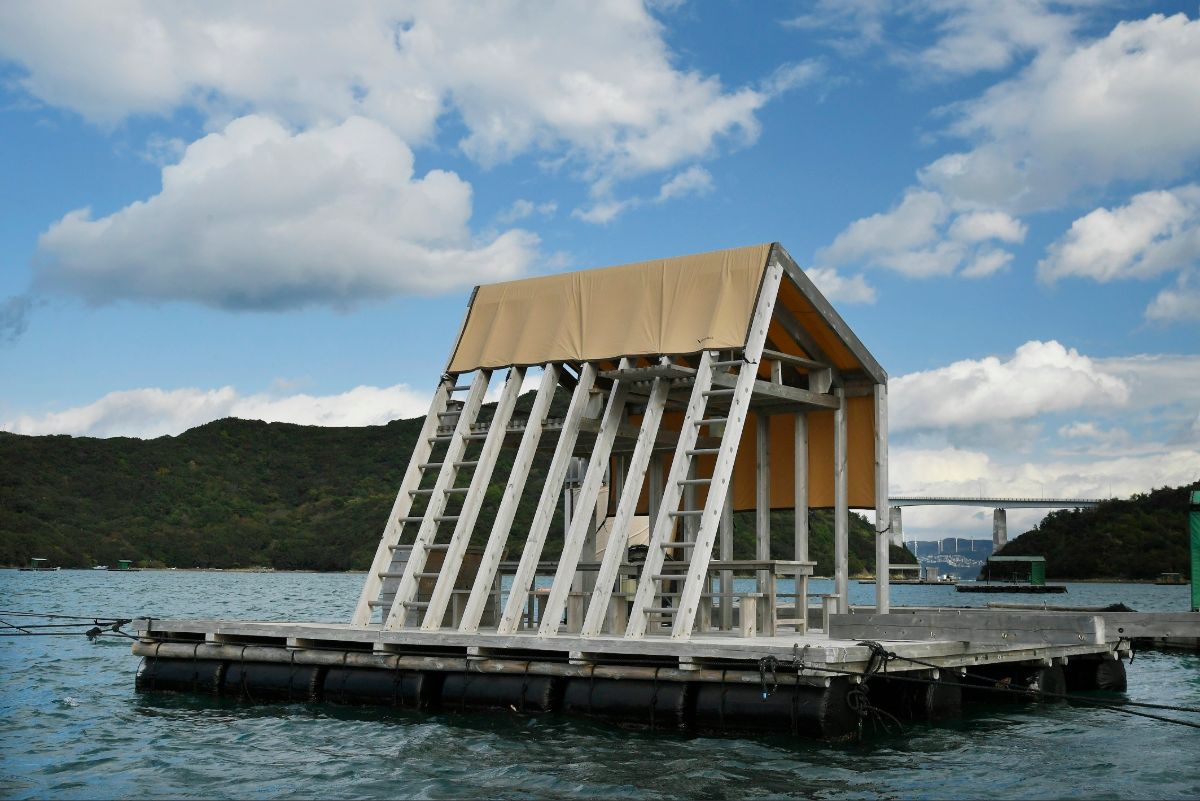
In addition to its Awa Odori performances, tonaru SETO offers half- and full-day fishing experiences. These take place on anchored wooden rafts in the nearby Uchinoumi Sea, an enclosed bay known for its calm waters. The excursions include fishing equipment and an instructor, so participants can show up empty-handed and need no prior experience. Instructors provide guidance on fishing techniques, and later on preparing and cooking the catch. This is done directly onboard the raft, so participants can enjoy the fish fresh out of the ocean. Fish commonly caught include olive flounder, horse mackerel, and sea bream.


Related Articles
-
 Adventure & Experience
4 days exploring hidden gems and natural scenery around Shikoku’s Iya Valley
-
 Adventure & Experience
Five Cycling Routes in Setouchi
-
.webp) Adventure & Experience
Adventure & Experience7 Authentic Experiences Exclusive to the Setouchi Region
-
 Adventure & Experience
Setouchi Trip Ideas that are better with a Private Guide
-
 Adventure & Experience
Nishi-Awa: Savor Slow Life Moments in Nature-Rich Hamlets Hidden Above the Clouds
-
 Adventure & Experience
7 Awe-Inspiring Off-the-Beaten-Path Experiences in Setouchi
-
 Adventure & Experience
Things to Do and Places to Visit in Tokushima Prefecture
-
 Adventure & Experience
Shimanami Kaido Cycling Road - A Cyclist's Paradise
RELATED DESTINATION
Tokushima
It has lots of tourism resources including the Naruto Strait, which has one of the largest eddying currents in the world, and the Iya Valley, which captivates everyone who sees its overwhelming natural scenery. The traditional Awa Dance Festival, which teems with 1.3 million tourists, is a must-see.